by naca-web | Nov 10, 2025 | Announcements, Blog, Shelter Operations
The Heart of Animal Welfare
Last week, we celebrated Animal Shelter Appreciation Week, a time to recognize the dedicated professionals who care for animals and serve their communities every single day. From cleaning kennels before the sun rises to comforting frightened pets, managing adoptions, and supporting families in crisis, shelter staff are the heart of animal welfare.
Their compassion, resilience, and commitment keep shelters running and communities thriving. They are often the first to greet an abandoned pet, the ones who help them heal, and the last to say goodbye when that animal finds their forever home.
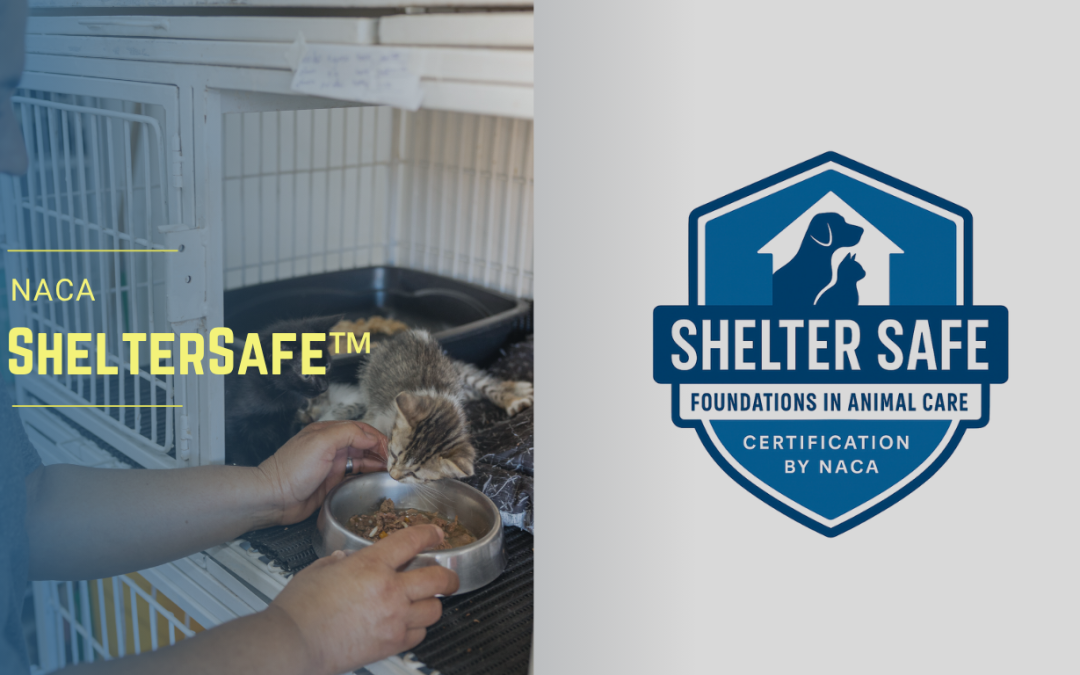
At NACA, we believe shelter staff deserve not only our gratitude — but also the training and tools to feel confident, safe, and supported in their work. That’s why we’re proud to announce the launch of our newest certification: ShelterSafe™.
The NACA ShelterSafe™ Certification is designed to strengthen the foundation for anyone working or volunteering in animal welfare — from new shelter employees to experienced team members looking to refresh their knowledge.
This self-paced certification introduces the core concepts every shelter or animal welfare professional should know — from the foundations of humane care and animal welfare principles, to understanding body language for safe interactions, and maintaining effective sanitation practices.
ShelterSafe™ can easily be integrated into your existing onboarding or training program. Agencies can even assign it before a new employee’s first day, ensuring they arrive with a strong understanding of animal welfare basics and workplace safety.
Investing in staff training is one of the most powerful ways a shelter can improve retention, morale, and community impact. When staff feel equipped and supported, they’re more likely to grow, stay, and lead within the organization.
The ShelterSafe™ Certification empowers agencies to build that foundation — one that supports both the animals and the people who care for them.
This course features updated best practices and expert-led instruction from leaders across the field of animal welfare, ensuring your team receives the most current, credible, and practical information available.
Take a moment to thank the incredible people behind every successful adoption, every clean kennel, and every wagging tail. Their compassion and dedication save lives every day.
To learn more about the ShelterSafe™ Certification or to enroll your team, visit dev.savvysites.net/.
Let’s celebrate our shelter heroes — and give them the tools they deserve to keep making a difference.
by naca-web | Feb 9, 2023 | Announcements, Blog, Position Statements, Shelter Operations
NACA Statement on Support of Updated Association of Shelter Veterinarian Guidelines
NACA leadership has reviewed the guidelines for standards of care in animal shelters issued in December 2022 by the Association of Shelter Veterinarians (ASV) and is pleased to provide an endorsement of this robust resource for shelter professionals. This is the first revision of the document, which was originally published in 2010.
At NACA, we feel the most significant updates to the 2022 version of the ASV guidelines center around the need for shelters to manage intake at all costs in order to ensure adequate care can be provided for the animals once they enter the shelter system. While “Both documents share the guiding principle that meeting each animal’s physical and emotional needs is the fundamental obligation of a shelter regardless of the mission of the organization or the challenges involved in meeting those needs”, the Second Edition focuses more heavily on the idea that prevention of intake is the solution to compliance with a capacity of care standards.
Shelters across America, and in particular municipal shelters, are facing an unprecedented disparity between intakes and outcomes, are forced to place incoming dogs in pop-up kennelsin hallways or conference rooms orreturn to the practice of space-based euthanasia (which most had successfully stopped or were on a path to stopping).According to Shelter Animals Count, 4% more animals entered shelters than left in 2022 and this is anincrease of 2% from 2021, the largest gap in the past four years.It is critical that our industry push outmessagesto the public about the necessity to limit intake based on available resources.
According to the new ASV guidelines, “admission must be balanced with the ability to provide appropriate outcomes, minimize LOS, and ensure the shelter remains within its capacity for care. Population management begins prior to admission: an animal must only be admitted if the shelter can provide the care they require.”Contingency plans for temporary/ emergency animal housing in times of capacity crises should be developed and in place if/ when they are needed.
The guidelines go on to state just how critically important it is in the scope of our work that we prioritize the quality of life in the shelter above all else.“Aversion to euthanasia is not an excuse for crowding and poor welfare”. Furthermore, “enrichment must be given the same significance as other components of animal care, such as nutrition and medical care, and is never considered optional.”
In addition to these key takeaways, NACA supports the updated standards of care recommendations and directives detailed in the updated ASV guidelines that cover nearly every aspect of shelter operations and encourages all animal services organizations to review the guidelines in their entirety and comply to the maximum extent possible.
by naca-web | Mar 21, 2022 | Announcements, Blog, News, Shelter Operations
As the chaos and unrest in Ukraine continues, we anticipate more families with pets will flee to safety here in the United States. Just yesterday, we learned a European airline flight landed in a major US city with a Ukrainian refugee and their dog. Airline personnel were unaware of which agency to contact, or the protocols involved with bringing a Ukrainian pet into the country. Ukraine is one of the countries listed as High Risk for Rabies by the Center for Disease Control.
To help your agency plan for potential refugees and their pets entering your community, the National Animal Care & Control Association, The Association for Animal Welfare Advancement, and the University of Wisconsin Shelter Medicine Program, are recommending Animal Care and Control agencies across the country prepare for the possibility of refugee families with pets seeking emergency entry into the United States traveling through international airports or borders.
Your agency might be required to help pets owned by Ukrainian refugees in this situation, most traveling from a European country that might have relaxed pet vaccination requirements. As animal welfare professionals we strive to provide service and safety to the public and animals. By being prepared with local, state, and federal procedures to assist with transportation, animal housing, supplies, and veterinary care, your agency can lessen the impact on families and help keep pets with their people.
Recommendations:
- Review and update your Preparedness Plan
- Connect with local government agencies within your area to stay informed of protocol changes
- Contact Customs with the international airport(s) in your jurisdiction as well as Border Patrol to ensure relationships are established, policies are clear, and contact information is accurate
- Please know that the CDC is making exceptions to the current ban on a case by case basis for family pets and individuals can reach out to cdcanimalimports@cdc.gov for information on allowing their dog into the US.
- Ask your shelter veterinarian to attend National Shelter Rounds on Tuesday, March 22 at 4 pm Eastern/ 3 pm Central/ 1 pm Pacific to learn more about how veterinarians should respond
Together, we can help ease the suffering and stress of Ukrainian refugees seeking sanctuary in the United States by helping them keep their pets and out of shelters.
by naca-web | Jan 3, 2022 | Blog, Field Services, Position Statements, Shelter Operations
!! NACA Alert !!
Across the U.S., Animal Services Agencies Face Unprecedented Hardships
We know you feel it, we feel it too! All across the U.S., animal services agencies are facing unprecedented hardships like short staffing, full shelters, and high emotions. If we have learned anything these past few COVID years, it’s that life can be unpredictable and no matter how hard we prepare, we are likely to experience the stress of it all.
From hospitals to child welfare agencies to airports, from homelessness services to restaurants, virtually every industry and sector are facing service disruptions and huge challenges due to the impacts of the COVID pandemic. Animal services organizations are no exception. Animal services and animal control organizations across the U.S. are experiencing short-staffing as well as higher-than-usual animal inventories, along with record-reported levels of stress and burnout among workers. Some of the specific challenges facing animal services agencies are:
- National animal shelter software data shows that while intake has not yet reached 2019 pre-pandemic levels, animal shelters are full. The data further shows that this is due to pet adoptions and transports slowing dramatically, and both cats and dogs are spending up to twice the number of days (from an average of 40 days to 80 days) in animal services custody.
- Short staffing in all positions, especially forward-facing staff, animal control officers, veterinarians, and customer service representatives due to comparably low salaries, difficulty, and stress of working conditions and environment, and slow hiring processes. The recent COVID variants are compounding short-staffing and bringing many organizations to critical staffing shortages.
- A nationwide veterinarian shortage means many shelters are unable to hire or retain veterinarians and, in some communities, this shortage causes a reduction in care for owned pets.
- An increasing number of animals are being surrendered due to the financial impacts of COVID and a high number of animal control calls related to evictions, abandonment, and poverty-based neglect.
- The stress of the pandemic has increased the number of emotionally charged instances and officers and shelter staff report a higher-than-usual number of negative interactions with the public, including people experiencing mental health crises and residents who are combative with shelter and animal control staff and volunteers.
The National Animal Care & Control Association recommends animal services agencies address these challenges in the following ways:
- Move into essential services status as needed. This protocol, released by NACA during the first months of the COVID pandemic, advises animal services agencies on essential and non-essential services during crisis periods. Organizations should consider moving into essential services status for 30-day increments as necessary due to shelters being at or above capacity and low staffing levels. Here is more information on what it means to provide essential animal services to your community.
- Provide emergency field services. If your animal control or field services unit faces temporary staffing shortages, here is NACA’s guideline on what animal services should be prioritized.
- Implement an appointment-based intake system for non-emergency intakes.
- Keep as many pets in their homes and communities as possible. Animal control officers should check found pets for any identification (including microchips) and return pets in the field without impounding them unless those pets truly need sheltering. For pets that have been found by a Good Samaritan, ask pet finders to upload found reports online, hold healthy and friendly pets in their homes, and help get lost pets back home without them having to come to the shelter. Animal control officers should transport impounded animal’s home when possible if their owners or caregivers do not have access to reliable transportation.
- Encourage supported self-rehoming. Ask people who need to surrender their pets to utilize a supported self-rehoming platform, like Rehome by Adopt-a-Pet or Home-to-Home instead of bringing those pets to the shelter.
- Provide pet support services. Offer food, supplies, shelter, and fencing assistance to pet owners in lieu of impoundment. Create local pet resource guides to help people find access to services and locate pet-inclusive housing options, as well as behavior and medical support for their pets.
- Help staff cope. Provide support for field and shelter staff and ensure staff have access to and are aware of mental health support services. Consider providing crisis intervention training to forward-facing staff and check-in to keep tabs on what staff is experiencing when engaging with the public. Make teamwork and communication a part of every day.
- Focus on keeping great staff. Assess whether your salaries and benefits are comparable to other similar jobs in the public and private sector. Conduct exit surveys to find out why staff leave and address the most common issues leading to high staff turnover. Ensure staff does not have to work mandatory overtime and when possible, pair up animal control officers.
- Work differently. Today, 98% of people report that pets are important family members, yet the challenges facing pet owners have never been more daunting. Consider changing operations to focus more on addressing the root causes that lead to citations, impoundment, and the separation of people and pets. If you’re not already doing it, allocate people power and funding to keep pets in their homes and communities and out of the shelter system. The shelter is a critically important resource for some pets, including those that are sick or injured, in immediate danger, or pose a threat to public safety. For many pets who do not fall into one of these categories, there are usually safe housing options in the community that are more humane, more cost-effective, and better for animals and people.
- Talk to your community. Communicate frequently with community members and explain to them why you are doing a particular program or following a certain policy. Explaining the why often helps the community get behind you and encourages them to be part of the solution too!
We realize that every agency and community is different, and each has its own unique set of nuisances. Our recommendations are to be used a guide to support you, your agencies and your communities in helping to get through these unprecedented hardships we are all feeling and experiencing.
Do you have other ideas or want to share what’s working for you? Let us know, we want to hear from you. Stay Safe!
NACA Staff and Board of Directors
Download PDF
by naca-web | May 26, 2020 | Blog, Shelter Operations
COVID-19 has changed our profession, possibly forever, and in many ways, for the better. We have started having real discussions with our state and local governments on what it means to be essential. We have adapted our shelter intake models, seeing intakes drop and adoptions soar. In light of these remarkable changes, you would expect to see the staff morale at our facilities sky-high, right? And maybe you are seeing that. But, if you, or your teammates are in a slump right now, it’s okay.
If your agency stopped taking non-critical intakes or calls for service, you likely feel like you’ve been running from one emergency to the next. That your kennels only have profoundly ill, injured or aggressive animals in them. That your citizens are stressed out and overwhelmed and those emotions are getting thrown at you, and if any of these feelings resonate with you, know that you are not alone.
Loudoun County Animal Services (LCAS) is a municipal animal services agency, in a community of about 400,000 people. Normally, this time of year, kittens are arriving at our door by the boxload, while calls for service on dogs running at large and concerns over wildlife keep everyone busy. This year, however, after closing to intakes, other than stray dogs (per county code) and urgent surrenders, our intake numbers dropped by over 70%. One the outside, this seems amazing- and it is! But while the animals still arriving are the same critical or aggressive cases we would normally receive, the boxes of kittens and “I’m moving” dogs aren’t coming in. This means that our staff are missing out on the happy endings that we all got into the field to experience, and don’t quite get the break in between tough cases that we are used to. And those tough cases might either feel harder, or they might actually be harder. Here in Loudoun, we have seen a sudden, substantial increase in violent crimes against animals locally, and bites where owners are the victim have gone up 72% in the past two months. While we should all be proud of the hard work we have done to make positive change, there is no shame in admitting that the current environment is a challenging one for us and our teammates, and these challenges go well beyond our trucks and kennels. Some of our colleagues are struggling to balance childcare, vulnerable family members and compromised income, along with the new stresses of work in a different environment. While we are all going through this pandemic together, we all have our own lives to balance with an already complex profession.
At LCAS, we are trying to keep the environment as low stress as possible- starting a staff garden, hosting grill-out Thursdays in the employee parking lot, permitting pets at work for our shelter staff and dispatchers, making sure everyone has PPE and what they need to feel safe, while allowing telework as much as possible and being flexible with staff schedules. No one has ever said that being essential is an easy job, but it is one that we have taken on with pride. And while the community trusts us to take care of their animals, we need to make sure we are also taking care of ourselves. Reduced intakes does not mean reduced stress.
There is no better time than the present to look after your own mental well-being. If you need to take time for yourself or your family, related to COVID-19, there are federal workplace protections in place for you. If you are feeling overwhelmed, you are not alone. Don’t hesitate to reach out to colleagues, to your locality’s EAP, professional therapists, hotlines or other support networks. Times are changing, and in many ways, it is for the better, but it doesn’t mean that your struggles should be discounted. Recognizing our challenges is the first step in resilience, and while our stats, our resources and our communities are different, we are all in this together. And when we come out on the other side (are we there yet?), I want you all here alongside me to try to tackle the next round of progress in animal services.
Nina Stively is the Director of Loudoun County Animal Services, a municipal agency in northern Virginia, handling animal sheltering, humane law enforcement and community programs for a community of about 400,000 people, full of companion animals, livestock and wildlife.
by naca-web | May 15, 2020 | Blog, Community Outreach, Field Services, Shelter Operations
Dear fellow animal welfare professionals
We are living through some very difficult times right now, yet those of us in the animal care and control field are persevering. NACA is committed to being by the side of every single person putting themself at risk to continue serving the animals and people in their communities. We also recognize that there are many of you who want to serve but cannot due to lay-offs, furloughs, reduced hours and slashed budgets.
With these challenges in mind, NACA is giving everyone the opportunity to share in the unity we provide and the benefits afforded to all members at a more reasonable cost. We have decided to cut our annual membership fee of $50 in half to $25, or only $20 if you are a member of a member state-affiliated association!
When we offered a free three-month trial membership in March, the response was overwhelming! Close to 900 people signed up and many began immediately accessing our benefits, such as viewing the archived training webinars that were conducted in partnership with the Justice Clearinghouse.
We took this immense interest as a sign that if NACA were more affordable, more people would join in our fight to bring our field the pride, professionalism and unity it deserves. To those of you who signed up as a full member sometime after March 1, we are extending your membership to a two-year, fully paid membership giving you an additional year of benefits.
While times are tough out there, they are also tough here at NACA. We have been forced to cancel far too many of our NACHO training classes that we do in partnership with Code 3 (cancelling just one is too many in my book!). These trainings are not only our longstanding pledge to you to provide world-class animal control and humane law officer certification training, they also represent a significant source of our annual revenue.
So why would cutting fees now be sensible? Wouldn’t the more advisable path be to increase costs?
Perhaps, but that doesn’t sit right with me, not when I meet and talk to officers, shelter staff and advocates who are living paycheck to paycheck yet still want to be a part of the NACA family.
NACA’s strength has always been and will continue to be in our numbers. I know that not only will we get through these dark times, we will get through them together as one.
Stay safe and stay proud.
Scott Giacoppo
Board President,
National Animal Care and Control Association